EAGLEXOR

Digital marketing for ecommerce brands

Ecommerce digital marketing, run as one connected plan.

We plan and run search, paid ads, email and SMS, and content around one set of goals for your store. Channels support each other instead of competing for credit, and you see what each one actually adds.

See how it works
Bald eagle soaring high above a city at night, wings spread wide over glowing streets and a river

See every channel from one vantage point, then move them together.

  • One plan across every channel
  • Budget decisions tied to margin
  • One report, shared definitions

Signs your channels are pulling in different directions.

These problems rarely sit inside one channel. They appear between channels, which is why fixing each channel on its own does not make them go away.

  1. Every channel reports a win, but revenue barely moves.

    Why it happens: Each platform counts the same order as its own, so the reported totals add up to more than you sold.

  2. The ad promises one thing and the landing page says another.

    Why it happens: Campaigns and pages are planned by different people, on different schedules.

  3. Loyal customers keep receiving first-order discounts.

    Why it happens: Customer lists are not shared between paid media and email, so buyers stay in acquisition audiences.

  4. One customer gets an ad, an email, and a text about the same offer on the same day.

    Why it happens: No shared calendar decides which channel says what, and when.

  5. This year's budget split looks a lot like last year's.

    Why it happens: Spend is set by habit or by whoever asks loudest, not by margin and evidence.

  6. Nobody can explain the path from first visit to second order.

    Why it happens: Each team sees its own slice of the data, measured its own way.

None of these is fixed inside one channel. They are fixed by planning the channels together.

The channels we plan and run together.

Each channel has a job in the plan. We choose the mix after the audit: most stores do not need every channel at once, and some need one fixed before another can work.

Charcoal water bottle on a low plinth, surrounded by a phone with a glowing screen, a wax-sealed envelope, a closed magazine, a magnifying glass, and a wrapped parcel on a dark table
The same products and the same offer, told consistently in every channel.
  • Search (SEO)

    Its job: Be found by people already looking for what you sell.

    What we run: Technical fixes, collection and product pages, and content that answers buying questions.

    Search engine optimization
  • Paid search & Shopping

    Its job: Show up for high-intent searches with the right product and price.

    What we run: Google Search, Shopping, and Performance Max campaigns, feeds, and budgets.

    PPC management
  • Paid social

    Its job: Introduce the brand to new customers and bring back recent visitors.

    What we run: Meta and TikTok campaigns, audiences, and creative testing.

    PPC management
  • Email & SMS

    Its job: Turn first orders into repeat customers.

    What we run: Welcome, abandonment, and post-purchase flows, plus a campaign calendar.

    Email and SMS marketing
  • Content & creative

    Its job: Give every channel something worth showing.

    What we run: Creative briefs, product stories, buying guides, and ad concepts.

    Part of every plan
  • Landing pages & CRO

    Its job: Make sure the click turns into an order.

    What we run: Campaign landing pages, product page fixes, and testing where traffic allows.

    Conversion rate optimization
  • Analytics & tracking

    Its job: Count every sale once, and know where it came from.

    What we run: Tracking audit, GA4 and platform events, and shared reporting.

    Analytics and tracking

How the channels hand off across the customer journey.

Shoppers do not experience channels; they experience your brand. We plan what each channel does at each stage, and how it passes the customer on to the next.

Map your customer journey
  1. Woman at a city bus stop at night looking at her phone, holding a charcoal water bottle in her other hand

    Stage 1 of 4

    Discover

    The shopper
    Notices the brand for the first time, usually on social or in search results.
    Channels that lead
    Paid social, search, content
    The handoff we plan
    People who engage are remembered, so the next ad or email continues the story instead of repeating the introduction.
  2. Two hands holding a charcoal and a sand-coloured water bottle side by side above a dark wooden table, with a phone lying face down

    Stage 2 of 4

    Consider

    The shopper
    Compares options, reads reviews, and checks the price, delivery, and returns.
    Channels that lead
    Search, Shopping ads, retargeting, email sign-up
    The handoff we plan
    New subscribers get a welcome series that answers the questions people ask before their first order.
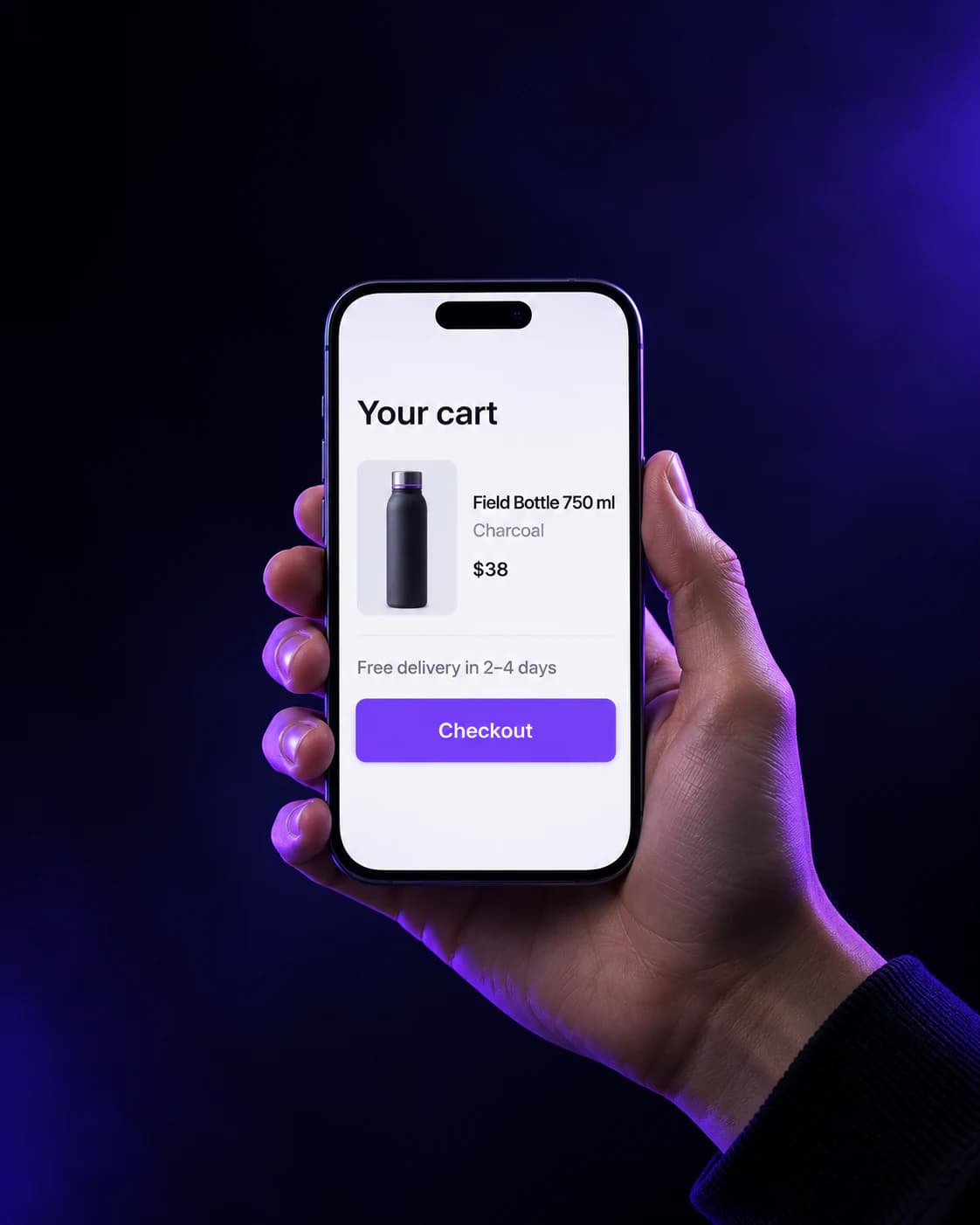
  3. Hand holding a phone showing an illustrative cart with one Field Bottle 750 ml in charcoal at $38, free delivery in 2–4 days, and a Checkout buttonIllustrative store

    Stage 3 of 4

    Buy

    The shopper
    Decides, adds to cart, and checks out, or leaves with the cart still full.
    Channels that lead
    Landing and product pages, abandonment email and SMS
    The handoff we plan
    Abandoned carts are followed up by email and SMS first, so paid retargeting is not paying for orders that would have come back anyway.
  4. Hand lifting a charcoal water bottle out of an open black shipping box on a kitchen counter in early-morning light

    Stage 4 of 4

    Come back

    The shopper
    Receives the order, uses it, and decides whether to buy again.
    Channels that lead
    Email, SMS, post-purchase content
    The handoff we plan
    Customers move out of acquisition audiences and into retention flows, so they stop seeing first-order offers.

How we plan and run it.

A clear sequence to start, then a steady weekly, monthly, and quarterly rhythm. How long each step takes depends on what the audit finds.

Start with a marketing audit
  1. To start

    Step 1: Audit

    We review every channel you run, the tracking behind it, your margins, and how customers currently find you and buy.

    Output: Marketing audit with prioritized issues

  2. Before anything launches

    Step 2: Plan

    We agree shared goals, give each channel its job, split the budget, and set the offers and messages for the quarter.

    Output: Channel plan, budget split, and campaign calendar

  3. Launch

    Step 3: Build and launch

    We fix tracking first, then build or rebuild campaigns, flows, and landing pages, and brief the creative each channel needs.

    Output: Live campaigns and flows, with tracking checked

  4. Every week

    Step 4: Optimize

    We adjust budgets, bids, audiences, creative, and messages based on what the numbers show, and log every change.

    Output: Weekly change log

  5. Monthly and quarterly

    Step 5: Report and re-plan

    Each month we report what every channel added and what we changed. Each quarter we revisit the plan and the budget split.

    Output: Monthly report and quarterly plan review

How we decide where the budget goes.

Every ad platform takes credit for the same sale. We judge channels by what the business actually gained, and we say plainly what the numbers cannot prove.

Review your budget split
Black and brass balance scale on a dark desk, tipped by violet tokens on one pan against cyan and white tokens on the other

One report across every channel, using the same definitions everywhere.

  • Total revenue against total marketing spend

    Shows: Whether marketing as a whole is paying back.

    Can hide: Which channels are doing the work.

  • Cost to acquire a new customer

    Shows: What it costs to win a first order.

    Can hide: Whether those customers ever buy again.

  • Contribution after marketing

    Shows: What is left after product, shipping, and marketing costs.

    Can hide: Longer-term effects on the brand.

  • Platform-reported return

    Shows: How campaigns compare inside one platform.

    Can hide: Double counting, because every platform claims the same sale.

  • Holdout and incrementality tests

    Shows: What a channel adds beyond what would have happened anyway.

    Can hide: Not much, but they need enough orders and time to give a clear answer.

  • Repeat purchase rate

    Shows: Whether email, SMS, and the post-purchase experience are working.

    Can hide: Recent changes, because the effect takes months to show.

Where the volume allows, we test what a channel really adds by holding it back from a group of customers or a region. Where it does not, we say the evidence is weaker and plan around that.

How we work with your team.

We can run every channel ourselves, or lead the plan and work alongside your in-house team and other agencies. Either way, every channel has a named owner and everyone works from the same plan.

Weekly
A short check-in on spend, results, anything unusual, and the decisions that cannot wait.
Monthly
One report across every channel, what we changed and why, and next month's priorities.
Quarterly
A review of goals, the budget split, and the channel mix for the quarter ahead.

What you receive

  • Marketing audit
  • Channel plan and budget split
  • Campaign calendar
  • Creative briefs
  • Tracking fixes and shared definitions
  • Weekly change log
  • Monthly report
  • Quarterly plan review
Need a wider growth roadmap first? Ecommerce growth strategy
Top-down view of four people's hands lining up blank cards along a violet line on a dark meeting table
Shared tracking and shared definitions, so every team reads the same numbers.

Digital marketing questions, answered plainly.

Something else on your mind?

  • Search (SEO), paid search and Shopping, paid social on platforms such as Meta and TikTok, email and SMS, content, landing pages, and the tracking that connects them. We recommend the mix after the audit; most stores do not need every channel at once.

  • No. We can run everything, or lead the plan and work alongside your in-house team and other agencies. Each channel gets a named owner, and everyone works from the same plan, calendar, and report.

  • There is no single minimum. It depends on your margins, average order value, the channels that suit your customers, and how quickly you want answers. After the audit we tell you whether your budget can do what you are asking of it, and where it would go furthest.

  • One monthly report across every channel, using the same definitions everywhere: revenue, marketing spend, new customers, and contribution after marketing. Each platform's own figures sit alongside, so you can see where they disagree.

  • It depends on the channel and on what the audit finds. Fixing tracking, budgets, and broken campaigns can show up quickly, while search, content, and retention work builds over months. The plan sets expectations for each channel, and the monthly report shows progress against them.

  • No. Results depend on your product, margins, competition, and market. What we commit to is a clear plan, careful execution, and honest reporting on what each channel adds.

  • Access to your store, analytics, ad accounts, and email platform, plus your margins, goals, and any past reports or plans. We confirm the exact list after the first conversation.

  • Specialists improve their own channel, measured their own way. We plan the channels together, with one set of goals, one budget view, and one report, so channels stop competing for credit and customers get a consistent experience.

Find out what your channels could do together.

Here is what happens after you get in touch.

  1. Tell us about your store, the channels you run today, and who runs them.
  2. We review it and work out what we would need access to for a proper audit.
  3. We reply with a recommended first step, usually a marketing audit, or tell you if something else should come first.
Low-poly black and graphite eagle in flight, wings spread wide with violet light along the feathers

Start your digital marketing enquiry

Tell us what needs to move.

Share the bottleneck, the timing, and what a useful outcome looks like. We review the context and reply with a useful next step.

Prefer email? hello@eaglexor.com

Required fields are validated before submission.