Sitemap and navigation
How customers move from the homepage to the right product in as few steps as possible.

How EAGLEXOR runs Shopify and ecommerce projects. Strategy comes first, so every design, build, and growth decision has a reason behind it.
Every phase answers one question and produces a clear output. Work only moves forward once you have seen it and signed it off.
What does the business need to win next?
What are we building, and in what order?
How should the store look, feel, and sell?
How do we make it fast, stable, and measurable?
Is it ready for real customers?
What will move revenue from here?
We learn how your business makes money, who your customers are, and where the current store gets in the way. Every later decision traces back to this phase.
Discovery brief
Four lenses, built with you
Goals, margins, and the numbers that matter
Who buys, why they buy, and what stops them
What the current setup can and cannot do
How competitors sell the same category
This phase ends with
Structure decides whether a store is easy to shop, easy to manage, and easy to grow. We agree on it together, so design and development start from a clear brief.
How customers move from the homepage to the right product in as few steps as possible.
The layouts every page is built from: home, collection, product, cart, and content pages.
What copy and imagery each page needs, and who is responsible for it.
Platform, apps, integrations, and migration needs written down before estimates.
The events and reports we will use to judge whether the new store works.
You approve: the sitemap, template list, content plan, technical scope, and a phase-by-phase timeline.
Design starts with the shopper's decisions, not a mood board. Templates are reviewed on mobile first, and feedback is collected in one shared place until you sign off.
Type, color, and photography direction that make the brand recognizable on every page.

Imagery, benefits, sizing, delivery, and reviews placed exactly where shoppers look for them.

Thumb-friendly layouts, a visible buy button, and fewer steps between product and payment.
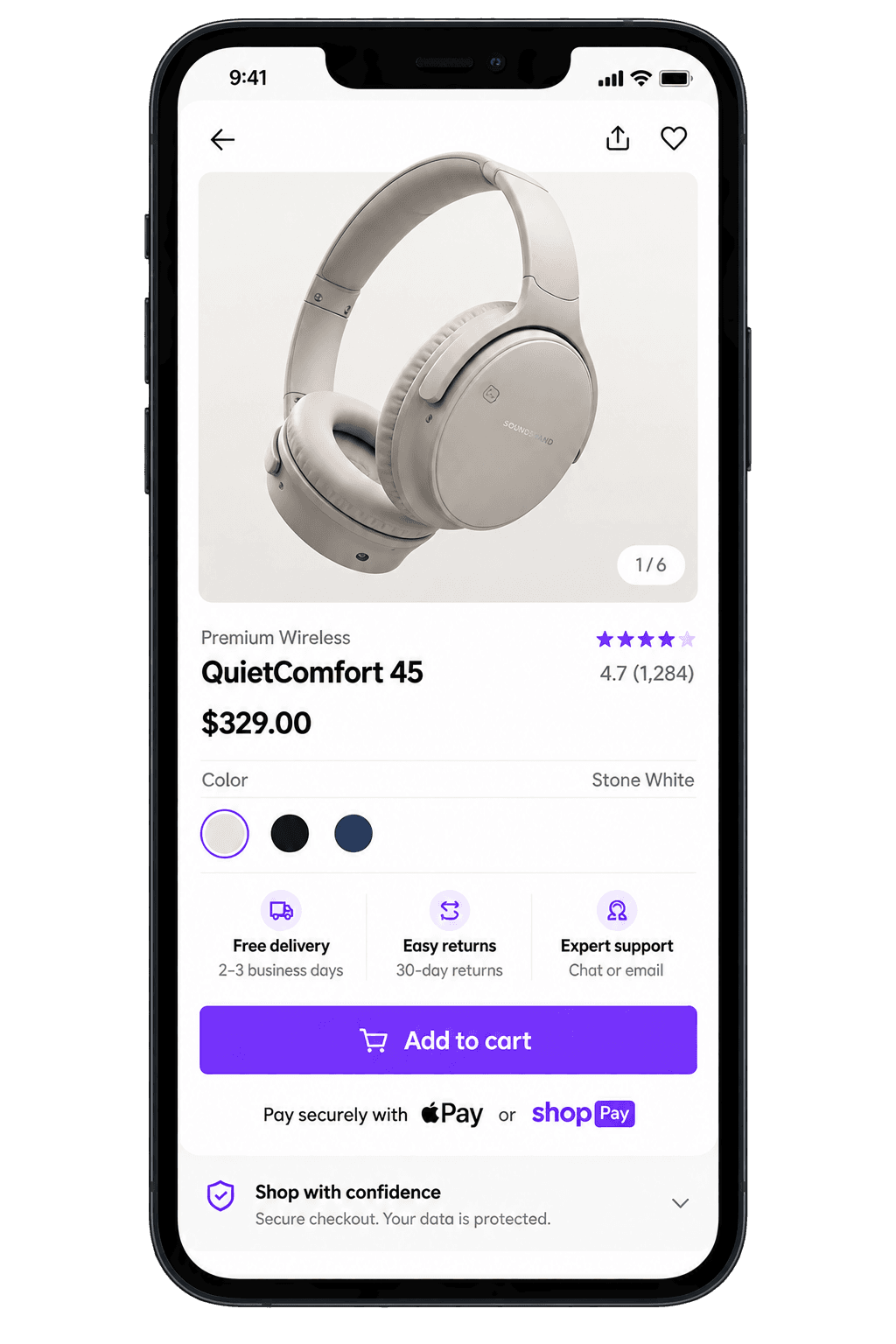
Filters, sorting, and product cards designed so customers can compare quickly.

We develop on Shopify, Shopify Plus, or Next.js depending on what the business needs, then connect the tools you already rely on. You test everything on a staging store before launch.
Your team can create new pages without calling a developer.
Images, scripts, and apps are checked against page speed as we build.
Email, reviews, subscriptions, and support tools connected and verified.
Analytics and ad platform events are wired in before launch, not after.


 Email and SMS
 Reviews
 Subscriptions
 Support
 Analytics
 Ad pixel
Before go-live, the store is tested the way customers, search engines, and ad platforms will use it. You see the results before anything goes live.
Content freeze
Final copy, products, and settings are locked for testing.
Full QA pass
Every check below, on real devices and real payment methods.
Fix and re-test
Issues are logged, fixed, and checked again, not just closed.
Your sign-off
You review the results and approve the go-live.
Go live and monitor
We launch at a planned time and watch orders and tracking closely.
Examples from a typical Shopify launch
Launch is the starting line. After go-live we run a monthly cycle across the channels that matter most to your store, and report on it in plain language.
You always know what is happening this week, what comes next, and what we need from you.
Kickoff
Goals, owners, timeline, and communication channels agreed.
Weekly check-in
A short call on progress, blockers, and decisions needed.
Shared board
Tasks, files, and feedback in one place you can open anytime.
Phase sign-off
Each phase ends with your approval before the next one starts.
Monthly report
After launch, results and next priorities in plain language.
Something specific to your store? Ask us directly.
It depends on scope. A focused Shopify redesign moves faster than a migration with custom integrations. Your proposal includes a phase-by-phase timeline, and we update it in the weekly check-in if anything changes.
Yes, in some form. For smaller projects it can be a short workshop and a store audit. It is how we avoid designing the wrong thing or quoting the wrong scope.
We need one decision owner, consolidated feedback during review rounds, and access to your accounts and content. Between reviews we handle the work and send a written update every week.
We write up the change and its effect on timeline and cost, and only start once you approve it. Nothing is added to the project without your agreement.
Yes. Many projects start from an existing Shopify store. We review what is working, keep it where it makes sense, and replace only what holds the store back.
We monitor orders, tracking, and site health closely after go-live and fix anything that comes up. From there you can continue with ongoing CRO, SEO, PPC, or email and SMS work on a monthly cycle.
Yes. We can own the whole project or a defined part of it. Responsibilities between your team, other partners, and EAGLEXOR are agreed at kickoff.
Tell us where your store is today and where it needs to go. We will recommend the right starting phase and a scope that fits.